










If you’re here, you probably already know the itch, the burning, the discharge. What you want to know is whether probiotics help. The honest answer: they show real promise for supporting vaginal balance and reducing recurrence, but the strongest evidence puts them alongside antifungal treatment, not in place of it.
That distinction stays front and center here. There’s a real difference between clearing an active yeast infection and reducing how often they come back, and probiotics fit those two jobs very differently.
There’s also a catch: “probiotics” isn’t one thing. The benefits come down to specific strains, and a label that just says Lactobacillus without a strain name can’t really be evaluated.

Do Probiotics Help With Yeast Infections?
Here’s the short version. Certain probiotic strains can support a healthier vaginal microbiome and may help reduce recurrence, but they don’t reliably clear an infection that’s already flaring.
A yeast infection, clinically called vulvovaginal candidiasis (VVC), happens when Candida yeast overgrows in an environment that normally keeps it in check. Antifungal medication is what resolves that active overgrowth. Probiotics work on the surrounding conditions, supporting the balance of good bacteria that makes overgrowth less likely in the first place.
How Candida Overgrowth Disrupts Vaginal Balance
A healthy vagina runs acidic. When it’s dominated by Lactobacillus bacteria, the pH sits around 3.8 to 4.5, and that acidity helps keep Candida and other microbes in check.
Candida isn’t an outside invader. It’s a fungus that already lives in the body in small amounts. A yeast infection is an overgrowth of something that was always there, which is exactly why restoring balance is the goal rather than sterilizing the area.
Several things can tip that balance. Antibiotics wipe out good bacteria along with the bad. Hormonal shifts from pregnancy or birth control change the environment. High blood sugar and a weakened immune system can also give yeast an opening to multiply. If you want the fuller picture, we cover the common triggers behind a yeast infection in more depth separately.
The Vaginal Microbiome and the Role of Lactobacillus
Lactobacillus does more than sit quietly in a healthy vagina. It actively defends the space. These bacteria produce lactic acid and hydrogen peroxide, compounds that make the environment inhospitable to Candida, and research shows they compete with yeast for room and resources.
That competitive edge is the mechanism behind most strain claims. Lab studies show that vaginal lactobacilli, including L. crispatus, can inhibit C. albicans growth and its shift into the more aggressive hyphal form.
There’s also a gut connection. The gut and vaginal microbiomes influence each other, which is why some probiotics taken orally are studied for vaginal outcomes rather than only digestive ones. This gut-vagina axis is the reasoning behind daily oral probiotics for intimate health.

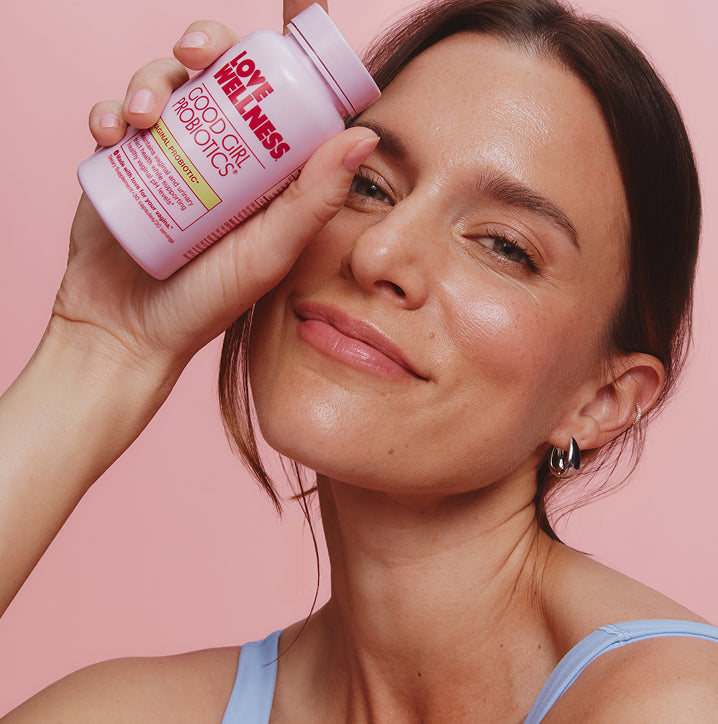
Products built around this mechanism reflect it in their formulas. Our Good Girl Probiotics® is an oral vaginal probiotic formulated with pH-supporting and Lactobacillus-based strains, designed to support the vaginal microbiome through that same gut connection.
One caveat sets up the next section: not all Lactobacillus species behave the same way. The genus name alone tells you almost nothing about what a strain has been shown to do.
Which Probiotic Strains Have Evidence
This is the part most shelf products gloss over, and it’s the part that matters most. Benefits are strain-specific. A few strains carry most of the research weight for vaginal health.
-
Lactobacillus rhamnosus (GR-1): The most-studied strain for recurrence support. It’s usually taken orally and was selected in part because earlier trials found reduced BV occurrence at doses around one billion CFU.
-
Lactobacillus reuteri (RC-14): Almost always paired with GR-1 in vaginal-health research. Together the two have shown anti-Candida activity in lab models, inhibiting yeast growth.
-
Lactobacillus crispatus: A dominant native species in a healthy vagina and a strong producer of the compounds that keep pH low. It’s often delivered vaginally and colonizes more durably than transient oral strains.
-
Lactobacillus acidophilus: The most common strain on shelves and the most-researched for maintaining healthy vaginal balance. It’s a solid daily-balance strain, though it isn’t the recurrence research star that the GR-1/RC-14 pairing is.
The pattern here is the takeaway. GR-1 and RC-14 lead the recurrence research, while L. crispatus is the native heavyweight for pH and colonization. If a product lists only “Lactobacillus” with no strain designation, you can’t match it to any of this evidence.
For daily pH support, our Good Girl Probiotics® is built on L. acidophilus and L. plantarum across nine strains, so it fits the everyday-balance use case rather than the recurrence-strain research above. Reading the label against the strain is the whole skill, and we’ll come back to it.
Oral vs Vaginal Probiotics: Which Delivery Works?
Delivery method changes what a probiotic can realistically do. The two main formats work differently.
Oral probiotics are the convenient daily option. The idea is that beneficial strains travel through the gut and reach the vaginal tract via the gut-vagina axis. Onset is slower, but they support your whole-body microbiome at the same time.
Vaginal probiotics, usually a suppository or insert, deliver bacteria directly to the site. That can mean faster local colonization, though the practicality of a nightly insert is a real consideration for daily use.
One point of confusion worth clearing up: boric acid is not a probiotic. It’s an acidifying agent that supports a low vaginal pH, and it contains no live bacteria at all. It sits in a different category entirely, so don’t file it alongside your probiotic choices.
Probiotics vs. Antifungal Treatment
This is the section to slow down on, because getting the roles right saves a lot of frustration. Antifungals and probiotics do different jobs.
Antifungal medications, including oral fluconazole and over-the-counter miconazole or clotrimazole, resolve an active overgrowth. Probiotics support the environment that makes overgrowth less likely to return. One clears the fire; the other maintains conditions so it’s less likely to reignite.
The research backs this division of labor. Fluconazole outperforms probiotics for treating active VVC, but combining the two has been shown to reduce recurrence and improve symptoms compared with antifungal treatment alone.
A Cochrane review of randomized trials found the same pattern for yeast specifically: adding probiotics to antifungal treatment improved short-term cure rates and lowered one-month relapse, though the reviewers rated the underlying trials low quality.
So can probiotics cure an active yeast infection on their own? The measured answer is no, not reliably. They’re best understood as support, not treatment.
Where the maintenance case is strongest is recurrent infection. That’s often defined as three or more episodes in a year under US guidelines, though European and IDSA guidelines use four or more. If you’re in that cycle, the daily-probiotic-as-prevention approach has the most to offer.
How to Choose a Probiotic Worth Taking
Once you know strains are the thing, choosing gets a lot easier. Here’s what to check on a label.
-
Named, research-backed strains: Look for full designations like GR-1 or RC-14, not just a genus and species. A “proprietary blend” with no strain names is a red flag.
-
A meaningful CFU count: More isn’t automatically better. A sky-high number matters less than the right strains in a viable dose.
-
Delivery matched to your goal: Oral for daily balance, vaginal for targeted local support.
-
Third-party testing and viability: Confirm the strains stay alive through the product’s shelf life, and check storage requirements.
-
A clean formula: Skip unnecessary fillers and common allergens you don’t need.
Run a real product through those filters. Our Good Girl Probiotics® lists its strains by name, including Bacillus subtilis DE111® for absorption, L. plantarum for pH support, and L. acidophilus for vaginal balance. It delivers one billion CFU per capsule at time of manufacturing, with an inulin prebiotic, and it’s shelf-stable with no refrigeration needed.
Using Probiotics for Prevention vs. an Active Infection
How you use a probiotic depends on which job you’re asking it to do. The two scenarios call for different expectations.
For prevention, consistency is everything. A daily probiotic needs weeks to shift your microbiome, so results build over time rather than overnight. Taking one during and after a course of antibiotics is a common approach, since antibiotics are a leading trigger for imbalance.
During an active infection, a probiotic sits alongside treatment, not instead of it. Treat the infection with an antifungal as directed, and let the probiotic support your environment while you recover and beyond.
A few everyday habits reinforce balance without any overpromising: keeping blood sugar steady, wearing breathable cotton underwear, and skipping internal cleansers and douching. None of these is a cure. They’re the background conditions that make a balanced microbiome easier to maintain, and they pair well with the broader steps in our guide to fighting and preventing yeast infections.

For the yeast-balance angle specifically, our Healthy V® Vitamin is a complementary option. It isn’t a probiotic. It’s a botanical vitamin with grapefruit seed, turmeric root, and garlic root that’s formulated to maintain balanced levels of Candida yeast with antioxidant and immune support, and taking it alongside a probiotic can be helpful in supporting a balanced vaginal flora.
What Probiotics Can’t Do, and When to See a Doctor
Trust comes from naming the limits plainly, so here they are. A probiotic won’t reliably clear a severe active infection, and several claims marketed on probiotic bottles don’t have meaningful evidence behind them. The research picture is promising but mixed, and honest sources say so.
There are also clear moments to skip the self-guided route and see a clinician:
-
It’s your first time having these symptoms and you haven’t been diagnosed before.
-
You’re getting recurrent infections, several in a year.
-
You’re pregnant.
-
Symptoms don’t clear after treatment, or they keep returning.
-
You’re not sure what you’re dealing with. Yeast symptoms overlap with bacterial vaginosis and some STIs, and treating the wrong thing wastes time.
This piece isn’t a diagnostic tool. When something feels off or unfamiliar, a provider is the right call.
Frequently Asked Questions
Can probiotics cure a yeast infection on their own?
Not reliably. Probiotics support a balanced vaginal microbiome and may help reduce recurrence, but they don’t clear an active overgrowth the way an antifungal does. For an active infection, treat it with an antifungal and use a probiotic as support.
How long do probiotics take to work for vaginal health?
Give it time. Shifting your microbiome typically takes several weeks of daily, consistent use, so probiotics are a maintenance habit rather than a quick fix. Results vary by person.
Can you take probiotics with antifungal medication at the same time?
Yes. They work on different things, so using them together is a common and complementary approach. The antifungal handles the active infection while the probiotic supports your environment.
Does eating yogurt help with a yeast infection?
Food sources like yogurt are fine to enjoy, but they’re an unreliable way to target vaginal health. Most contain relatively few live cultures, often lack the specific strains studied for the vagina, and come with added sugar. A targeted supplement gives you named strains at a known dose.
Matching the Right Tool to the Right Job
The clearest way to think about probiotics and yeast infections is by job. Antifungals clear an active infection. Probiotics support the balanced microbiome that makes the next one less likely, and their strongest evidence is as a complement to treatment and as daily maintenance for anyone stuck in a recurrence cycle.
From there it comes down to the label. Named strains matched to your goal beat a big CFU number or a vague “Lactobacillus” every time. Choose the strain for the job, stay consistent, and loop in a clinician when symptoms are new, stubborn, or unclear, so you can feel your best at every stage of life.
*