







You’re in the drugstore aisle, or scrolling a product grid at 11pm, holding a bottle that promises “freshness.” You’re wondering if it’s the thing that finally makes you feel comfortable, or the thing that makes it worse.
Feminine wash is a confusing category on purpose. The labels lean on words like “clean” and “deep clean” that sound reassuring and mean almost nothing.
Here’s the honest version. A good intimate wash cleanses the vulva gently, matches your skin’s naturally acidic pH, and skips the ingredients that irritate. That’s it.
This guide walks through how to read any product against those standards, so you can pick the best feminine wash for your body instead of the one with the prettiest bottle. Everything here is about external cleansing, and we’ll get to why that distinction matters most.
Vulva vs. Vagina: What a Wash Should Do
The single most useful thing to know before you buy any intimate wash: the vagina and the vulva are not the same, and only one of them should ever be washed.
Your vulva is the external skin, the labia, the area you can see and touch. It sweats, it comes into contact with fabric and discharge, and it benefits from gentle external cleansing.
Your vagina is the internal canal, and it cleans itself. As the U.S. Office on Women’s Health explains, washing inside with soaps or douches disrupts the natural balance and raises infection risk.
That internal balance runs on good bacteria, mostly Lactobacillus, which keep the environment acidic and help crowd out the bacteria linked to odor and irritation. A vaginal wash marketed to “clean inside” works against that system. The best feminine wash cleanses the vulva and leaves the vagina to do its own thing.
Why pH Matters More Than a “Clean” Feeling
The squeaky-clean feeling you get from regular soap isn’t a sign it’s working. It’s often a sign it stripped your skin.
Healthy vaginal pH sits in a mildly acidic range. Cleveland Clinic puts it at roughly 3.8 to 4.5 during your reproductive years, though it shifts before your period and after menopause. That acidity is protective. It’s the environment your good bacteria need to guard against odor-causing bacteria.
Standard bar soaps and body washes are built for the rest of your body, which runs at a more alkaline pH. Using them on delicate intimate skin can throw off the acid mantle that keeps things comfortable. That’s why the first thing to screen any wash for is a pH-balanced formula designed to match your body.
The Ingredient Checklist: What to Look For and Avoid
This is where most of your decisions get made. You don’t need to memorize chemistry. You need two short lists you can hold up against any label.
Ingredients Worth Looking For
-
pH-balanced or pH-buffered formulas so the product supports your natural acidity instead of disrupting it
-
Gentle, non-stripping cleansers including mild, coconut-derived surfactants that clean without scrubbing away moisture
-
Soothing, barrier-supporting ingredients like aloe vera, glycerin, and chamomile that help skin feel calm and hydrated
-
Fragrance-free formulas, the safest default for sensitive skin
-
Gynecologist- or OB/GYN-developed language, which signals the formula was built with intimate skin specifically in mind
Lactic acid also shows up on many well-formulated washes as an ingredient that supports the skin’s acidic environment. It’s a reasonable green flag when you see it.
Ingredients and Claims to Be Cautious About
-
Synthetic fragrance or "parfum," one of the most common irritants in intimate products
-
Harsh sulfates such as sodium lauryl sulfate (SLS) and SLES, which strip natural moisture
-
Parabens, dyes, and unnecessary antibacterials, none of which delicate skin needs day to day
-
“Douche,” “deep clean,” or “freshening” claims that imply internal use, which is the exact thing to avoid
-
Vague marketing words like “natural” and “gentle” with no formulation to back them up
That last one matters. “Natural” is not a safety guarantee. Essential oils are natural and still irritate plenty of people, which is why a fragrance-free formula often beats a “naturally scented” one for sensitive skin.
Matching a Wash to Your Needs
There isn’t one best feminine wash for everyone. The right pick depends on your skin and what you’re dealing with. Find yourself below.
1) Sensitive or Reactive Skin
If your skin reacts easily, go for the shortest ingredient list you can find, fragrance-free, with soothing agents like aloe. Introduce one new product at a time and patch-test on your inner arm first, so if something flares you know exactly what caused it.
2) Odor Concerns
Normal vaginal odor exists and changes across your cycle. That’s healthy. A persistent, strong, or fishy smell is different, and it can signal bacterial vaginosis or another issue that a wash won’t fix. Masking it with a fragranced product can make irritation worse.
If the smell is new and won’t quit, see a clinician instead of shopping. For the everyday kind, a gentle pH-matched wash and breathable habits go a long way, and our vaginal odor guide covers the difference in more depth.
3) Recurrent Irritation, Itching, or Infection History
If itching or irritation keeps cycling back, prioritize a barrier-friendly, pH-supportive formula and cut anything fragranced. And know the limit of what a wash can do. Recurrent infections deserve a medical evaluation, not another bottle. A wash is a hygiene product, not a treatment.
4) Everyday Maintenance vs. Freshening Up
For daily use, less is more. Once a day is plenty, and water-only cleansing is a completely legitimate baseline.

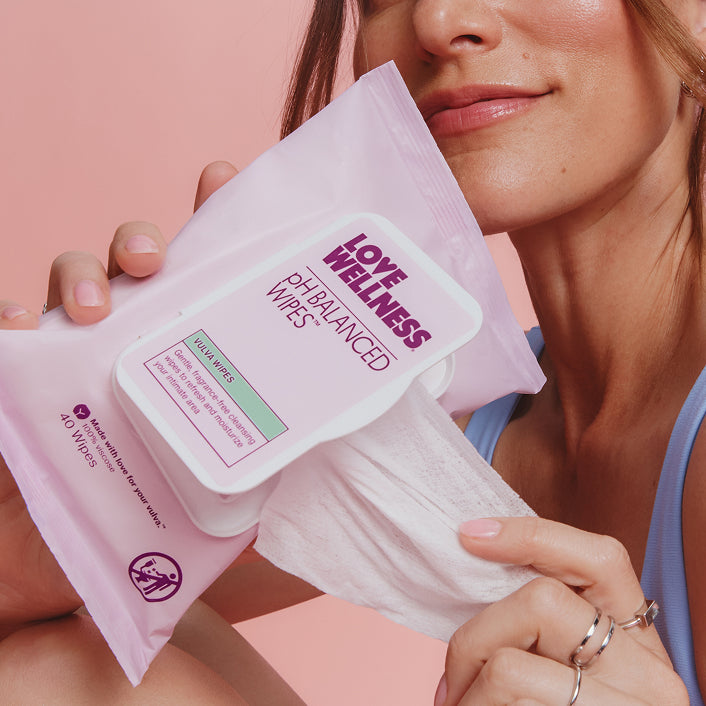
For a quick refresh after the gym or sex, a pH-balanced wipe made for external use, like our pH Balanced Wipes™, works as a between-washes option. It’s a refresh, not a replacement for washing, and not a reason to over-clean.
How to Read the Label and Marketing Claims
Once you can read a label yourself, no marketing claim can rush you. Front-of-pack language and the actual ingredient list often tell two different stories.
A few common claims, decoded. “Hypoallergenic” isn’t federally regulated and doesn’t guarantee you won’t react. “Clinically tested” only means something if the label says what was tested and on whom. “Gynecologist-approved” tells you a professional was involved but not what the formula contains. The ingredient list is the part that can’t spin you.
Transparency is the tell. A trustworthy product states its pH, discloses its full ingredient list, and specifies external use.

Our own pH Balanced Cleanser™ is a useful example of what that looks like on a label: a stated pH of 4.2, a full ingredient list, a clear “no” list (no fragrance, parabens, sulfates, dyes, harsh soaps, or essential oils), and external-use positioning. You should find that same clarity on any product you’re considering.
Comparing Common Types of Feminine Wash
The category breaks into a few formats. Judge each one on the criteria you’ve now got: pH match, gentle cleansing, fragrance-free, external use.
1) Fragrance-Free Gentle Cleansers
The safest starting point for most people, especially sensitive skin. The trade-off is that they don’t leave a lingering scent, which is the whole point. A typical profile pairs mild cleansers with soothing ingredients like aloe and a pH matched to your body.
2) pH-Balanced and Prebiotic Washes
This group leads with microbiome-supportive claims. Some use ingredients that support the skin’s acidic environment, like lactic acid; others market prebiotic ingredients, which are meant to feed good bacteria. Evidence for topical prebiotics in intimate washes is still thin, so read these claims closely.
A pH-balanced, fragrance-free, clinically studied formula, the profile our pH Balanced Cleanser™ fits, is a well-established version of this category even without a prebiotic ingredient.
3) Fragranced and “Freshening” Washes
These dominate shelves because “fresh” sells. The appeal is real. The trade-off is that added fragrance is a leading irritant for intimate skin, and the “fresh” feeling is cosmetic, not a sign of health. Not a hard no for everyone, but the wrong default for sensitive or reactive skin.
4) Soap Bars and Standard Body Wash
Short version: skip them for this job. They’re formulated for skin that runs at a different pH, and using them on the vulva can strip the acidic balance you’re trying to protect.
How to Use a Feminine Wash Correctly
Technique matters as much as the product. Even a well-chosen wash can irritate if you use it wrong.
Apply externally only, to the vulva, never inside the vagina. A small amount is enough. Rinse thoroughly so no residue sits on the skin, and pat dry rather than rubbing. Once a day is the ceiling for most people; more washing isn’t more hygienic.
If you want the technique in detail, we cover it in washing your vulva correctly.
Breathable cotton underwear helps the area stay comfortable between washes. And if a new product brings on stinging, burning, or redness, stop using it. That’s your skin telling you the formula doesn’t suit it, not a sign you need to push through.
When a Wash Isn’t the Answer
Here’s the part most product guides skip, because it doesn’t sell bottles. Sometimes the answer isn’t a better wash. It’s a doctor.
No feminine wash treats, cures, or prevents an infection. If you have a strong or fishy odor that won’t go away, unusual discharge, persistent itching, burning, or pain, those are signs to check with a clinician.
Bacterial vaginosis, yeast infections, and STIs need real evaluation, and washing more won’t resolve them. A wash supports healthy, comfortable intimate skin. It was never designed to do more than that, and any product claiming otherwise is overpromising.
Washing is one piece of intimate care. For the bigger picture, including pH support, probiotics, and daily habits, our vaginal health collection covers the full routine.
Choosing the Wash That Fits You
The best feminine wash isn’t a single product. It’s the one that matches your skin: external use only, pH-balanced to your body’s acidic range, fragrance-free if you’re sensitive, and honest about what’s inside the bottle. Once you can read a label against those four things, you’re no longer at the mercy of front-of-pack marketing.
Keep the vulva-versus-vagina rule at the center of it. Cleanse the outside gently, let the inside clean itself, and pay attention to what your body tells you. If something feels off and stays off, that’s a conversation for your clinician.
*


